
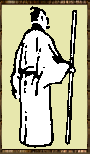

Concentrate on your question
then click the picture of the Wandering Sage
(or click here).
You can also choose a random hexagram from the list below . . . .
|
1 2 3 4 5 6 7 8 |
9 10 11 12 13 14 15 16 |
17 18 19 20 21 22 23 24 |
25 26 27 28 29 30 31 32 |
33 34 35 36 37 38 39 40 |
41 42 43 44 45 46 47 48 |
49 50 51 52 53 54 55 56 |
57 58 59 60 61 62 63 64 |
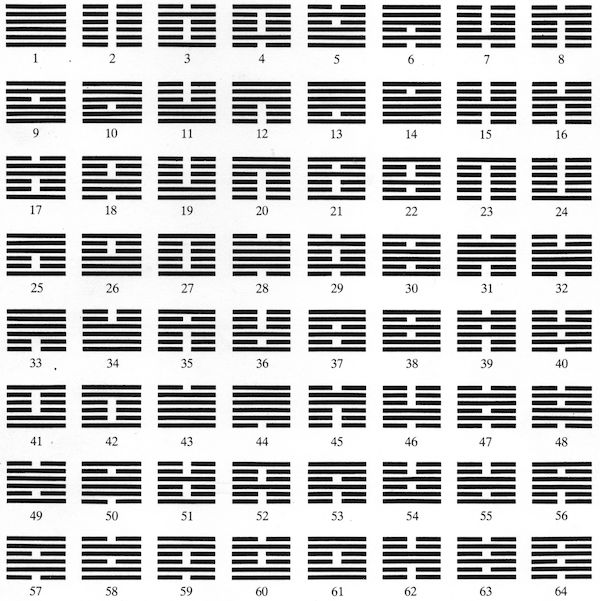
For a traditional reading, throw sticks or coins to choose a hexagram, then find it on this chart. The hexagrams read bottom to top. The first line is the bottom line, the sixth line is the top line.
The I Ching, now known as Yijing, is the ancient Daoist book of metaphors, written to offer guidance in the inevitable changes of life. The Yijing consists of sixty-four hexagrams, the number of combinations mathematically possible with six solid and broken lines. The broken lines "- -" are yin, or passive, dark, yielding. The solid lines are yang, active, light, reaching.
Ancient Daoist scholars recorded symbolic stories for each of the sixty-four combinations. The stories contain clues about your own life scenarios.
Think of your situation, and when you have your questions clearly in heart and mind, choose a hexagram.
Following is a quote from the book, Hauntings: Dispelling the Ghosts Who Run Our Lives, by Dr. James Hollis, a Jungian scholar. In chapter two, "On Synchronicity and Quantium Physics," he explains how the Yijing works through synchronicity. Hollis said:
The Yijing, to choose one example, utilizes a method that most Westerners would consider arbitrary or accidental to gain purchase on an interior causality. To the Western sensibility, casting coins or yarrow sticks seems fatally stricken with accident or chance. But the Eastern view is that the practitioner in a meditative mood enters the Dao of the moment, that is, participates in the qualitative dimension of reality. Thus the arrangment or conjunction of moments is not arbitrary after all, but takes on the qualitative textures of time and space.In all the hexagrams, at least one of the lines may predict bad results, but that does NOT mean you are destined to get that result. The meaning is to study your situation for what could go wrong.
From there, focus on the positive outcomes in other lines. Study how different attitudes lead to better outcomes.
Your future is in your hands. Consult the Yijing for ideas that lead to clear thinking and positive mental attitude. The Yijing teaches you to flow with changes. Create positive change from the inside through conscious living. Take the time to reflect on your attitudes and ideas.
Editor's Note The Yijing readings at this site are from my book, Learning to Flow with the Dao: The 64 Hexagrams of the Yijing. I wrote this interpretation in 1994, based on many years of study, and put it online at Surrealist.org in 2000. Every year, thousands of people visit this site to read their Yijing.
The Wandering Sage appears at this site with permission of Daoism Depot.
Learning to Flow with the Dao is also available as a book. Click here to find it at Amazon.com.
